Tuesday, June 21, 2011

Walking with Scissors


Once again I have waited far too long between blog posts.  And yes, I still have plumbing issues.

Me & the Kids at Florence's School Last Year
Every Wednesday, I have continued to volunteer at a preschool that is in a nearby low-income area and which is run by my neighbor and friend, Florence.  Since she has children from 2-7 years old, I was excited to see that she was able to expand her school from 1 to 2 classrooms while I gone.  She also has a few assistant teachers who work with her now.  A couple weeks ago, I found that she had a felt storyboard book that tells the story of Cinderella, which Florence had never been sure of how to use.  I took it home and practiced, and the kids were mesmerized as I ad-libbed the story, adding and removing felt characters, as appropriate.  I found it was a particularly effective way of showing how the pumpkin turned into a stagecoach and the mice turned into horses, etc.  As I read to kids, I find that many stories don’t really translate across cultures easily, but it was nice to see how Cinderella actually included many familiar characters: a king (they have tribal kings here), a girl who couldn’t afford nice clothes, a “pussycat”, and even a pumpkin (although Ugandan pumpkins are green, so at first some thought it was an apple).  I’m not sure how much they understood me, but I tried to bend the story towards: it didn’t matter what she wore or how much money she had, the prince loved her for who she was inside.  =)  (I decided that the “love at first sight because she was so beautiful” thing wasn’t a great lesson to teach the kids.)  

Last week, I brought the older kids (around kindergarten to 1st grade age) kid-friendly scissors so that they could practice their cutting (and safety) skills.  I first made them all demonstrate how to walk with scissors.  Then I had them all cut out various shapes that I had printed out (I was impressed that they were all able to identify the oval and diamond).  I was amazed at how accurate some of their cutting skills were, even the younger ones!  It just goes to show that people can be talented in different areas.  I then had them lay the cut-outs on the table under a larger piece of paper, which they colored over with crayons.  Some turned out better than others, but I think crayon rubbings are always fun.  Tomorrow I plan to try to same thing, but without scissors, on the younger kids.

Reading to the Kids Last Year (with fellow intern Dan)
Almost every Saturday, I have been reading books to some of the kids in another low-income neighborhood nearby.  Unfortunately many of the younger children still don’t know English, so I feel bad that a lot of the time they can’t follow the story, but I feel like it’s still good exposure for them, and some of the older kids who come by seem to be intrigued by the stories.  Because of the language barrier, I try to find stories that have funny sounds or are more interactive (counting or repeating words), and I try to be as creative as possible with different voices.  (Culturally-specific idiom-based humor, like in Amelia Bedelia, is completely lost on them.)  One of their favorites for me to read is a VeggieTales book, in which I attempt to do all of the different voices (as well as I can remember).  I think their (and my) favorite voice is the French Peas.  On Saturday, I found one of those books that shows different animals made out of produce, so we had fun trying to identify both the animals (they definitely didn’t know what a penguin was, but impressively the older ones knew octopus and that it lived in the water) and the foods (no kiwis or radishes in the Ugandan diet).  It was a book of baby animals, and at the end they show a baby human (I couldn’t for the life of me figure out what it was made out of, though), and we all laughed together because it was obviously a “baby mzungu!”

On an unrelated note, since it’s often sunny and rainy here, I had assumed that there were rainbows here and was assured by several Ugandans that there were, but I had never actually seen one until last month, looking out my back balcony.  Beautiful!


Saturday, May 28, 2011

We're Not Alone


On Monday, I went to a networking meeting for people who are interested in “member care,” i.e., supporting the missionaries in their organizations.  This is something that I’ve become really interested in pursuing for our office, so it was helpful to make some contacts in other organizations.  I was able to talk to one person about work permit questions, another offered her organization’s “Welcome to Uganda” info packet, and a couple people are willing to meet with us so we can swap ideas about how to care for or be helpful to the new folks who come to work with us.

I think my favorite part about the meeting, though, was just realizing that I’m not alone in this.  There are other people out there just like me, working in Kampala!  We at EMI don’t need to figure everything out on our own.  There are other organizations that we can share ideas with!  This was the first time that I had really met with people from other missionary/aid organizations in Uganda (other than the ministries that EMI works with).  It was refreshing to realize what a large community of organizations we are, even if we don’t get to see each other very often.  

It also served as an encouragement to try to reach out to other organizations and to share our resources and knowledge with each other.  We don’t have to keep reinventing the wheel.  This organization that hosted the meeting is based in Nairobi, and a network of Christian aid organizations has just started meeting there.  They were encouraging us to start doing something similar, or at least to start an email list that we can use to share information, etc.  We’ll see what happens, but it’s exciting to think about the possibility of continuing these networking-type of gatherings.  It reminded me a lot of when I was involved with running an AmeriCorps program.  There are hundreds of organizations all over the US that are running AmeriCorps programs.  I loved going to conferences and trainings and realizing we were part of a larger movement and also getting the opportunity for different programs to share questions, ideas, and lessons with each other.  It was extremely helpful and encouraging.  It would be great if something like that could start happening in Kampala amongst Christian and/or aid organizations.

In other news, the power has been going out a lot more often lately.  For the first couple of months I was here, it seemed to go out only once or twice a month, but for the last few weeks, it’s seemed like it’s about every 3-4 days.  I’ve been getting a lot more use out of my candles and flashlights.  Fortunately, my laptop battery is usually able to last through two TV episodes before I have to turn in for the night.  

The power has often been going out from around 8-10pm, which is when most people are using it all at once.  It could be that our area has just hit that point where so many people are using the power, that the system just can’t take it (like New York City several years back).  But I’m also wondering whether it’s “load shedding.”  This is where they intentionally turn off the power to a whole area to prevent overloading the system.  I think maybe they rotate areas each night.  I hope this doesn’t mean that we’re on some rotation and that it will keep going out every 3-4 days….  Oh well, it makes me grateful for the electricity that I do have.  (I’m so thankful for refrigerators and hot water showers!)

The plumbing, on the other hand, has been driving me crazy!  My shower faucet has been leaking ever since I moved in 3 months ago.  And my toilet has been overflowing for the last 2 months.  Fortunately, the plumbing is installed with easy-to-access shut-off valves.  Every time I flush the toilet, I turn the water valve on, wait for the tank to fill, flush, and then turn it off again. Every few weeks, I forget to turn it off at night and I wake up to a flooded bathroom…. =(  Fortunately the plumber is here right now with new parts, that should (supposedly) fix everything!  (I’ve heard that about 20 times before.)  In all fairness, this is somewhat my fault.  I wasn’t getting enough water pressure for my shower to work (because they installed the water storage tanks too low), so I had a plumber re-route my water supply to come directly from the city water so that I could take a shower.  Now I have a TON of water pressure, which I guess fixtures in Uganda aren’t made for…

Sunday, May 22, 2011

Oh, the Things You Can Eat!

Sorry that I haven't blogged for a month!  I appreciate all the "where'd you go?" and "how's your kitten?" questions I've heard about.  It lets me know that people are actually reading this thing!  =)

Mostly, I haven't blogged because nothing too exciting has happened.  I've finally settled into life as usual, so maybe I'll start sharing more about what is "usual."  I've been very busy at work, which is nice.  I've gotten to work on office budgeting; organizing logistics for a small team that is coming in June; helping another project team finish, edit, and format their final report and appendices; communicate with incoming staff/volunteers on things like housing and work permits; visit potential apartments for our incoming folks; and even revamp our office lunch menu! 

An interesting tidbit about my life is that our office employs a cook to make lunch for us five days a week, and we all sit around a big long table (in what used to be the garage) and eat lunch together at 1pm every day.  Currently our office lunch menu looks like this: Monday: beans, rice, chapati (flat bread), avocado; Tuesday: spaghetti with ground beef/tomato sauce, cooked greens; Wednesday: mashed potatoes with meat sauce (chunks of beef), toast; Thursday: beans, rice, freshly-made beef samosas (many people's favorite day); Friday: soft tacos with all the fixings; and every day includes a big bowl of fruit for dessert (pineapple and sometimes banana, mango, or watermelon, depending on what's in season).

I've decided that what characterizes North American food more than any particular ingredient is VARIETY.  We don't just eat European or even regional American foods; we eat Mexican, Indian, Chinese, Thai, Japanese, Korean, Middle Eastern, and Ethiopian food.  This variety can even be found at the local food court.  At EMI, we've already altered our menu a little to add more "mzungu" (foreigner/Westerner) foods, but now I'm working with our cook and a couple others to expand our rotating menu schedule from 5 meals to around 15 meals, adding more mzungu foods as well as as wider variety of Ugandan dishes.  Instead of having a weekly meal rotation, I hope to create a monthly food rotation, which will even include fish and chicken (maybe) once a month! 

For some reason, chicken is by far the most expensive meat here.  It's sad because that's about all I cook in the US, but I'm learning to make mostly vegetarian dishes at home since I often get beef at lunch.  In fact, I just bought chicken at the grocery store yesterday - my first time ever in Uganda!  Instead of splurging on chicken, I occasionally splurge on good cheese (also very expensive here).

On an unrelated note, which I thought of after I came up with the title of this blog, it is now grasshopper season.  This means that you can buy fried grasshoppers along the road for a snack.  People will even walk up to your car window to sell you a small bag-ful for only a few cents.  They're actually not as bad as they sound.  They pluck off the wings and legs first, so they're not really crunchy.  It's kind of like eating greasy popcorn....  Still, not my snack of choice.

My cat is doing well and growing.  She still drives me crazy a lot of the time, scratching and biting me, trying to eat all my food, and occasionally semi-destroying something in my house.  She's now big enough to get up onto every surface, so I have to be more diligent about what I leave out on the counter or even on the stove. Within a couple seconds, she'll be eating my breakfast or my freshly-baked cake!  She also likes to carry away small objects, so I've lost a couple things around the house that way.  But she's still a nice companion to have around.  My across-the-hall neighbors have a little girl, and a couple weeks ago they had some friends over with two more kids.  The three of them were fascinated with the cat.  I brought her to my doorway and let them pet her (although the boy just wanted to pull her tail and hit her).  Eventually they followed her into my house and were trying to pet her and play with her.  (I had to watch her closely to make sure she didn't start playing with her claws.)  Later, they pounded on my glass door to get her attention - kind of like a kid at the aquarium - they didn't quite understand that loud noises would scare her away.  Anyway, it was a nice chance to interact with the neighbors a little bit.

Wednesday, April 20, 2011

Cat with Bat


This is not exactly what I thought my life would look like in Uganda, but I now have my own cat!  The first week I was here, my mom and I saw a tiny little kitten in a parking lot next to a busy road and knew that it was abandoned.  Given my mom’s huge heart for animals and the cuteness and helplessness of the kitten, we rescued it.  My mom carried it in her shirt on a motorcycle taxi back to some friends’ house, who watched it for a few weeks until I returned from Gulu and was able to take it in myself.  Last year, I saw a tiny little kitten crossing the same major road and watched it get squished by the taxi that I was in, so this feels a little like I’m doing my part to help rescue one of the gazillion cats running around the streets of Kampala.  

Chloe and Pooh (are not friends because Pooh has now gone into hiding)
Chloe (I started with “Clementine” because we found her in front of the Orange store, but somehow I ended up with “Chloe” [I think all animal names should be 2 syllables max]) is a calico and full of energy (as I suppose any kitten is).  But I’ve had several kittens and she is by far the feisty-est, which is saying a lot (for those of you who are familiar with Doris, the cat my roommates and I got in Boston).  She loves to play-fight with her claws and teeth, which are very sharp (making it annoying instead of cute).  She also loves to snuggle, which is great (I’ve always wanted a cat who wants to sit on my lap), but she almost loves it too much, and is always trying to walk across my laptop and eat my food and play with anything I’m using.  It’s been an interesting few weeks getting used to each other and figuring out how to live with a (very needy/mischievous) kitten. 

Since I’m living in Uganda, I wanted to try to come up with some cheaper form of food for her than store-bought cat food.  What I’m doing right now is boiling corn flour and water and adding in these tiny local dried fish (you can buy a cup for $0.30).  Then I mix in some store-bought cat food to round out the nutrition.  =)

The first night I had her, we had a HUGE wind storm.  Before I could close all the windows, it actually knocked over a corner bookshelf that I have in my living room!  (I think the wind caught the curtain, which pushed the not-super-stable tripod unit over.)  It practically landed on top of Chloe, who was sleeping on the couch, who then flew across the room in fright.  Then I felt bad leaving her out in the living room by herself on her first night, so I took her to bed with me.  She got used to sleeping with me (did I mention she’s very needy/snuggly?), so I let her keep doing it.  One of her favorite places to sleep was on top of my head.  (Not above my head on the pillow, but actually on the back of my head, while I lay on my stomach.)  Eventually I decided sleeping with me is probably not the best habit, so now I have to trick her out of my room every night before I go to bed.  (She’s getting smart and trying to hide in my room when she knows I’m getting ready to go to sleep.)

Chloe with Her First Cat Toy (mouse with fluffy tail)
Monday morning, I saw her carrying around one of her new mouse toys.  I thought it looked a little different but I was half asleep and I just figured she had pulled off the big fluffy tail in the night.  Then I noticed blood on the floor and thought she had somehow started bleeding, but couldn’t find any blood or wounds on her.  Finally it dawned on me that perhaps the funny-looking mouse toy I had seen her with was actually a real mouse, so I started checking under all the furniture.  Finally I noticed some blood on my mosquito net and then found a small bat wrapped up in it on the floor.  (Thank you for the present, Chloe.)  Fortunately it was fully dead, and fortunately I found it, and fortunately she had not left me a present ON my bed!  Still, pretty gross.  Although, it is crazy that there was actually a bat in my apartment AND that my kitten actually caught it!  Anyway, I read Fox in Sox to some kids this weekend, so this whole episode with a cat and a bat reminded me of Dr. Seuss, hence the blog title.  (Unfortunately I couldn't come up with anything more creative.)

[On a tangent note, I read “Green Eggs and Ham” to some kids today, and out of the whole story, the part they loved and laughed at the most was the name “Sam-I-Am.”  Go figure.]

Monday, April 11, 2011

Watoto Restore Tour

Well, the power just went out.  Fortunately, this is only one of the couple times that it’s been out at night in the last couple months.  My computer says it should last another 2.5 hours.  We’ll see.

(Source of photos: Watoto.com)
Last Friday, I got to see the Watoto Restore Tour.  The Watoto Children’s Choir basically NEVER performs in Uganda (so if they come through your town, be sure to see them!), so I was really excited about this opportunity.  The Restore Tour is different than a typical Watoto Children’s Choir performance.  There were a few children, but it was mostly young adults.  And instead of a typical concert, it was more like telling a story through music, dance, song, video, and spoken word.  It was the story of Gulu, which I explained in a previous post.  This was particularly the story of the children who were affected by the war: the boys who were kidnapped and forced to become soldiers and the girls who were either raped and left in their villages or kidnapped to be given as soldiers “wives.”  It was amazingly powerful because the people sharing stories during the performance were the actual people who had lived the stories; all the testimonies were given by their actual subjects.  Since the war started almost 30 years ago, many of those who were children at the time are now in their 20s and 30s.

Another thing that made the performance so powerful was that the whole focus was on forgiveness and hope.  The young adults who had lived through these terrible acts or even committed these terrible acts stood up on stage and pronounced their forgiveness of the perpetrators, of the LRA leaders, and of themselves.  And they pronounced the hope they have for their communities through the forgiveness and healing power of the love of Jesus.  It is only through God’s love for each individual, his forgiveness, and his call to forgive one another that true healing and restoration can be achieved in northern Uganda.

The Restore Tour had just finished traveling around the globe for six months, and their last performance was given at the main Watoto Church for VIPs only.  Many important government workers, including Members of Parliament, “governors,” and mayors were there.  Watoto wanted them to understand the work that they are trying to do in Gulu, that it’s not about Watoto, but it’s about Uganda. 

Because our EMI team had just done a project to design Watoto’s new agriculture/technical college in Gulu, one of the Watoto staff suggested that we ask to be put on the VIP list.  I forgot to follow up on this until a few days before the performance.  Fortunately, at the last minute, we were able to request and be put on the VIP list.  About 24 hours before the performance, we found out we were going and we found out that it was a formal event!  Of course we weren’t going to buy formal gowns (which it turned out would have been overdressed anyway), but we wanted to go for as nice of wedding-type apparel as we could pull off.  So all day Friday was pretty much a clothing/shopping day, and very little work was accomplished.  The 4 male interns went downtown to buy shirts, ties, shoes, etc. in the local shops along the streets.  I and the 2 female interns wanted to avoid going shopping if possible (ironic, huh?), but we managed to come up with some dresses, shoes, and jewelry from what we had with us and what we could borrow from a couple of the staff wives.  We had to leave the office at about 3:30 to change and then take a special hire taxi downtown to have dinner before the performance so that we could beat the crazy rush hour traffic.  (Another part of the day became less than productive due to the fact that one of the intern’s boyfriends showed up in Uganda completely unannounced [with the help of the sneaky intern coordinators] and proposed to her!)  What an exciting day!

Ok, now it’s time to go do my laundry with the help of my headlamp.

Wednesday, March 30, 2011

More Reflections on the Gulu Project Trip

Exploring the Site [photo: Tim]
To pick up where I left off, after our group visit to the 400+ acres of land on Tuesday (March 8), everyone spent the rest of the week working back at the guest house with their calculators, sketch pads, and laptops.  Only a few people ventured out to the site occasionally to collect information.  I didn’t mind staying back, though, because it was pretty hot the whole week, and at least the guest house had shade and fans (well, when we had electricity).  [Thank you to everyone who prayed for me in dealing with the heat.  Even though I was hot and sweaty most of the time, it didn’t ever get to the point where I felt sick or irritable, which is an answer to prayer!]  We had a whole section of the guest house to ourselves, which was great, because we basically took over!  We had 4 sleeping rooms surrounding a big living room area, where the architects spread out on a big dining table, and the engineers spread out around a circle of couches.

Engineers Hard at Work [photo: Kirk]
Testing Water at a Spring [Andrew]
I spent the first part of the week working with the water/wastewater team, since that’s what I’m most familiar with, and also somewhat helping John (the team leader) to coordinate/identify the numerous tasks to be done.  I was put in charge of coordinating the presentation, which is what I spent much of the end of the week doing.  I drew little diagrams in PPT and talked with the various teams (architects, structural engineers, civil engineers, agriculture, and livestock) to identify what was needed for their part of the presentation.
Architects (and Engineers) Hard at Work [Terry]
One day, about half of us (those who weren’t out at the site) walked into town for lunch.  I think it was about a half hour walk, and it was really dusty, hot, and sunny, so we were all grateful for the semi-air-conditioned western-style cafĂ©.  On the way back, we took a “short cut,” which ended up taking about 2 hours!  One of the guys had GPS on his iPhone, so he knew which way the guest house was, but we kept trying these small side streets, which would end up turning or taking us into someone’s yard.  I think we crossed over some train tracks 2 or 3 times….
Traditional Brick Huts [Chad]
While it was long and hot and exhausting, it was a pretty neat experience because we basically ended up walking around residential “neighborhoods” most of the time.  It was interesting because we were on the outskirts of a major city, but it looked just like “the village” (although more concentrated), since most people were living in small round brick huts with thatched roofs.  I later found out that this unusual settling pattern was a result of the history of the area.  Families moved near the city (often into relatives’ yards) to gain protection from the LRA, so they set up simple “temporary” housing resembling their own houses out in the villages.  25 years later they are still living in these “huts”, many of which have been improved and added onto along the way.

Discussing a Sketch of the Site Master Plan [Kirk]
On this trip, EMI was uniquely partnered with an architecture firm from Australia, which has already been working with Watoto to create a masterplan for the development of Gulu town.  It’s exciting to see that a church/ministry is getting involved in caring for the improvement and restoration of an entire city and region.  Often ministries are only set up to help those “within their gates,” which can be of great benefit to those in the program, but I was excited to see this “bigger picture” approach, especially for a war-torn region that has needs at every level of its society.  The agricultural and technical college is a part of that bigger vision for raising up citizens to have skills that they can use to further develop their own communities.  Also, because of Watoto’s and the architecture firm’s connections, the incoming mayor of Gulu attended our presentation at the end of the week.  We think it was a great opportunity for the new mayor to understand Watoto’s vision for the college and also their overall desire to work with the government to help improve the region.

Nearby Church Under Construction [Andrew]
One of the cool things that happened on the trip involved structural engineering.  (Don’t roll your eyes yet.)  Our structural engineer and architects ended up having a really long conversation one night to try to figure out how to make these buildings both seismically safe and buildable.  (Watoto often has teams of volunteers come and build parts of their buildings, and we wanted to create a design that would allow that model to continue.)  Gulu is in a region that is more seismically active than Kampala, so it was great that we had a structural engineer on our team who works for a firm that specializes in seismic design.  The team finally came up with some pretty creative (and cool-looking) building designs, but we were a little worried about selling the ideas as well as the importance of designing for earthquakes.  (It is of course hard to want to spend money to prevent something that doesn’t happen very often – just like car insurance!)  We thought we were going to have to convince our audience that an earthquake really could happen in Gulu.  But the amazing thing was that ON THE MORNING of our final presentation, the entire region was woken up at 6:20am by a 5.0 earthquake!  How amazing is that!  It wasn’t big enough to cause damage, fortunately, but just big enough for everyone to feel it and to be reminded that Gulu is located in a seismically-active zone.  God has great timing (and a sense of humor)!  Who knows, maybe that one earthquake will cause buildings to be built better and save lives in the future!

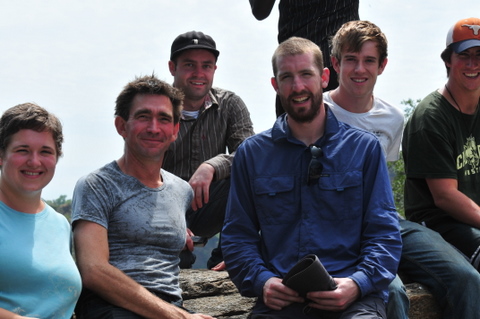
Me, Tony, Chad, Andrew, Angus, and K2 on a Rock in the Middle of the Nile (really) [Kirk]
I had a wonderful week and a half, and found that it was just what I needed as I was transitioning back into living in Uganda and working with EMI.  I was worried that I would find it too exhausting or overwhelming to go straight from moving to Uganda and spending a week setting up my apartment to leaving again for a busy project trip, but instead it left me feeling energized and excited for the road ahead.  Thank you again for all your prayers in that regard.  I feel like God knew exactly what I needed, even though it didn’t necessarily seem to make sense.  The camaraderie and positivity of the team and the fun times we had together were life-giving, and the project itself was a great reminder about the difference that EMI is making in partnering with ministries that are doing great work here in East Africa.

Some more pictures of the trip (courtesy of my teammates):

Playing Games at the Watoto Children's Village [Kirk]


John Challenging the Little Ones to a Match [Terry]
My New Friend at the Watoto Babies' Home [Kirk]


Meal Time! [Chad]
Some Nighttime Visitors at our Safari Camp [Andrew]
Hartebeest [Tim]
Us and the Lions, No Camera Tricks (aka Does Angus look like Lunch?) [Kirk]
Riding in Style along the Banks of the Nile/Lake Albert [Kirk]
Having Fun in the Safari Van [Kirk]